SUMMARY
This is AI generated summarization, which may have errors. For context, always refer to the full article.
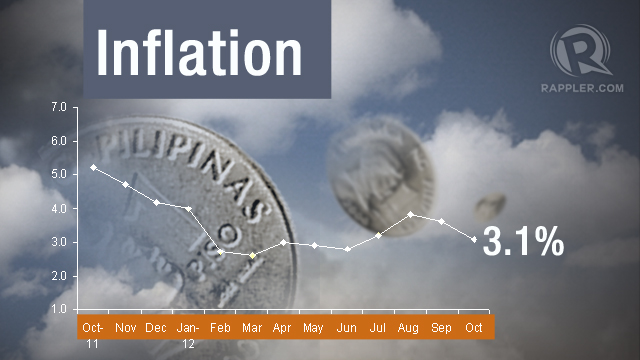
MANILA, Philippines (UPDATED) – The Philippines’ annual inflation — or the rate of increase in consumer prices — eased to a 4-month low of 3.1% in October, supporting the central bank’s recent move to cut its policy rates in order to boost economic activity.
The rate was the lowest since June, when annual inflation stood at 2.8%, data from the National Statistics Office (NSO) showed. It was also much lower than the 3.6% rate recorded in September.
For the first 10 months, inflation averaged 3.2%, near the low-end of the government’s target of 3% to 5%.
The NSO attributed the slowdown in October inflation to lower food and energy prices.
“Price declines were observed in the heavily-weighted food items, particularly rice and vegetables,” it said.
“Reductions in the prices of selected food items such as fish, cooking oil and some condiments and seasonings along with lower charges in electricity rates and the price decreases in gasoline and diesel in many regions also contributed to the downtrend,” it added.
Rosemarie Edillon of National Economic and Development Authority’s planning and policy staff said benign inflation suggests easing demand pressures on prices.
“These should be able to contain inflation for the rest of the year,” she said.
Record low rates
Inflation is one of the key factors that monetary authorities look at when they set their interest rates, which influence the rates that banks charge on their loans.
Low bank rates boost demand for loans, which, in turn, encourage households and businesses to spend for goods and investments. Increased consumption drives consumer prices up.
Late last month, the Monetary Board of the Bangko Sentral ng Pilipinas (BSP) cut benchmark interest rates to new record lows of 3.5% for overnight borrowing, and 5.5% for overnight lending.
The move, the BSP said, was meant to increase economic activity to offset the impact of the global downturn on the country’s growth.
The Philippines is eyeing a growth of between 5% and 6% this year, after a 3.7% growth in 2011. – Rappler.com
Add a comment
How does this make you feel?
![[In This Economy] A counter-rejoinder in the economic charter change debate](https://www.rappler.com/tachyon/2024/04/TL-counter-rejoinder-apr-20-2024.jpg?resize=257%2C257&crop=267px%2C0px%2C720px%2C720px)
![[Vantage Point] Joey Salceda says 8% GDP growth attainable](https://www.rappler.com/tachyon/2024/04/tl-salceda-gdp-growth-04192024.jpg?resize=257%2C257&crop_strategy=attention)
![[ANALYSIS] A new advocacy in race to financial literacy](https://www.rappler.com/tachyon/2024/04/advocacy-race-financial-literacy-April-19-2024.jpg?resize=257%2C257&crop_strategy=attention)

There are no comments yet. Add your comment to start the conversation.